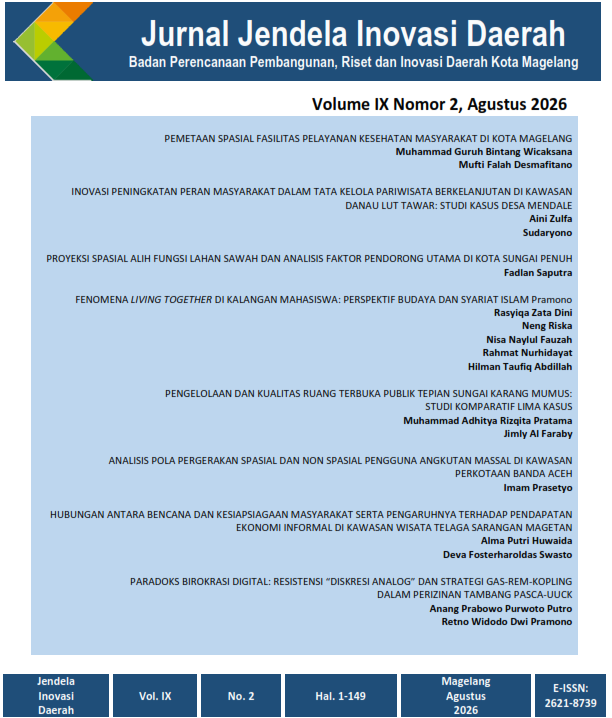
PARADOKS BIROKRASI DIGITAL: RESISTENSI “DISKRESI ANALOG” DAN STRATEGI GAS-REM-KOPLING DALAM PERIZINAN TAMBANG PASCA-UUCK
Abstract
The implementation of the Online Single Submission (OSS) system during the 2021–2025 period has created a bureaucratic paradox in Magelang Regency due to the inability of central algorithms to accommodate the spatial sensitivities of the Mount Merapi volcanic area and the Borobudur World Heritage Site. This study aims to examine the implementation challenges of OSS and analyze local bureaucratic adaptation strategies in addressing inconsistencies in licensing procedures. The research employs a deductive qualitative approach with a case study design. Data were collected through participatory observation and in-depth interviews with 12 key informants selected using purposive and snowball sampling techniques, and analyzed through pattern matching. The findings reveal a stagnation involving 35 Mining Business License (IUP) applications processed through the self-declare pathway, which were automatically issued without adequate spatial validation, thereby creating residual risks for local governments. In response, local bureaucracies developed adaptation strategies through the “Gas-Rem-Kopling” mechanism and the informal institutionalization of “Klinik Pra-OSS” (Pre-OSS Consultation Clinic). These practices represent “analog discretion,” defined as the reintroduction of human judgment and local knowledge to address risks overlooked by automated systems. This study concludes that digital transformation should not eliminate human agency, as bureaucratic discretion serves as a vital safeguard in adaptive licensing governance and the protection of living spaces.
Copyright (c) 2026 Jurnal Jendela Inovasi Daerah

This work is licensed under a Creative Commons Attribution-NonCommercial-NoDerivatives 4.0 International License.